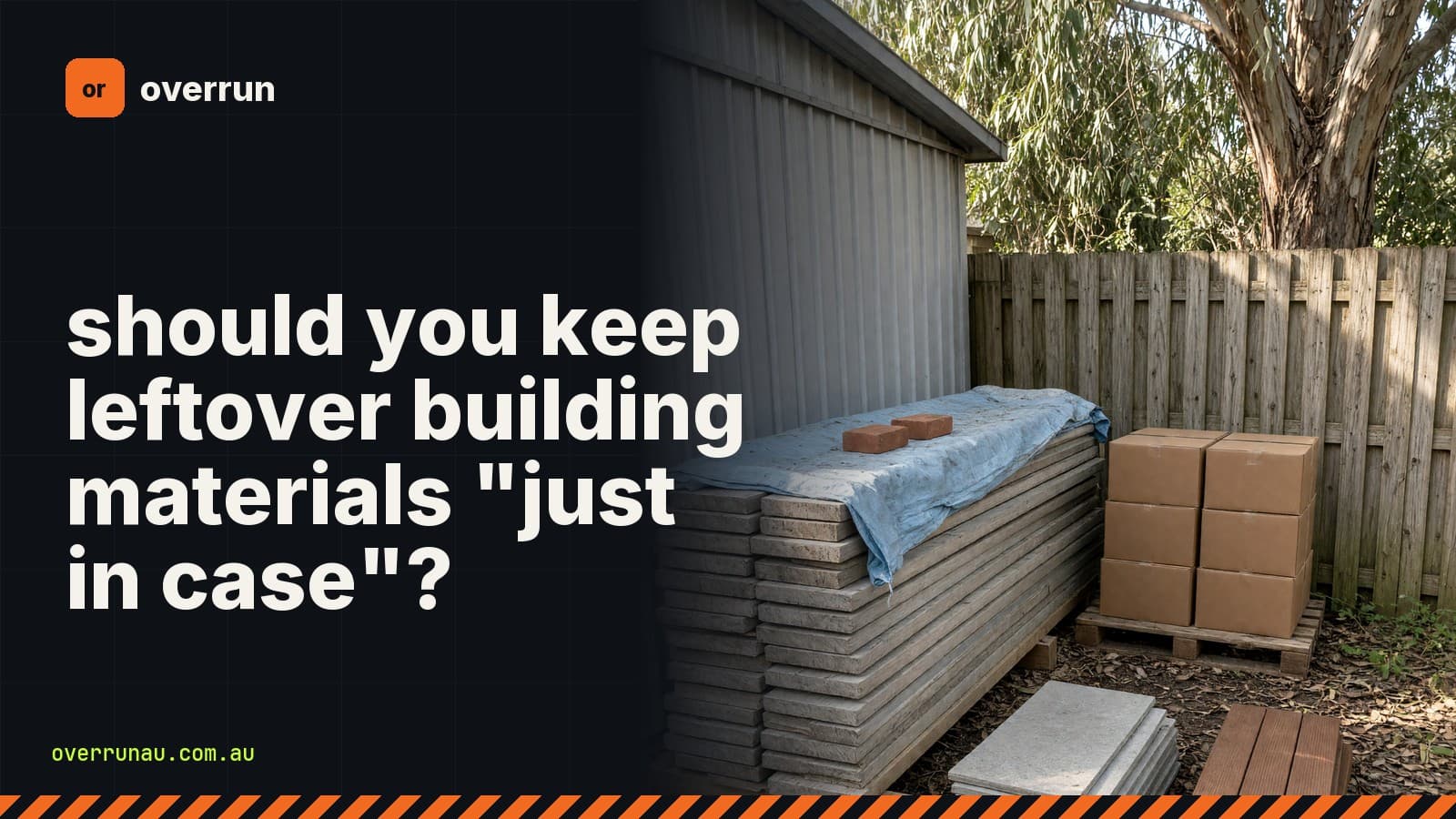
Every tradie has one. A pile behind the shed, a corner of the garage, a ute tray that hasn't been empty since winter. Timber from a deck two years ago. Six boxes of tiles from a bathroom. A few lengths of Colorbond, some fittings, half a pallet of pavers under a tarp.
It all got kept for the same reason. It's good stuff, you paid for it, and you might need it.
I'm Chelsea, I run Overrun. It was my husband's idea, he's on the tools, and the stash is a big part of why it exists. So here's an honest look at whether keeping leftovers "just in case" is actually worth it, and how to decide what stays and what goes.
Why the stash happens
Nobody sets out to build a pile. It happens at the end of a job, when you're tired, the client wants you gone and the next job started yesterday. Taking it home is the fastest option. Throwing it out feels like a waste, because it is. And working out who'd want it, and what it's worth, is a job for another day.
So it goes in the shed. Then the next job adds a bit more.
What keeping it actually costs
Keeping leftovers feels free because you've already paid for them. It isn't.
Space. The stash takes up room you could be using. A ute tray carrying last month's leftovers is a ute tray you're loading around them every morning.
Condition. Most materials don't age well in a shed or under a tarp. Timber cups and gets borers or water stains. Plasterboard gets damp. Tile boxes go soft and the corners get knocked. Bags of anything go hard. The longer it sits, the less it's worth to anyone, including you.
Time. Digging through the pile to find the one length you need, moving it to get to something else, restacking it after the wind gets under the tarp.
The clean-out. This is the big one. Eventually the shed gets cleared, the house gets sold or someone's had enough, and the whole lot goes in a skip. In Sydney, a 6 cubic metre general waste skip runs roughly $625 to $1,175 according to Whatsthedamage's October 2026 pricing, and the NSW metro waste levy went up again on 1 July to $180.20 a tonne. So you paid for it once to buy it, and again to get rid of it.
Keep it or move it on: a simple test
Some of it is worth keeping. Here's a rough way to sort it.
Worth keeping:
- Material for a job you're still on, or matching stock a client may need for repairs, like a box of tiles from the same batch.
- The stuff you genuinely use on every job, in the sizes you always use.
- Anything you'd have to special order and wait weeks for if you ran short.
Probably time to move it on:
- Leftovers from a finished job with no follow-up work.
- Colours, profiles or sizes you don't normally use.
- Anything you've moved during a clean-out at least once without using it.
- Anything that's starting to go: water marks, warping, soft boxes, rust.
If you're not sure, ask yourself whether you'd buy it again today for your next job. If the answer's no, you're only storing it.
The date trick
One thing that helps: when something goes on the pile, write the date on it. Pencil on the timber, marker on the box. Next time you clean out the shed, anything with an old date on it that hasn't been touched goes. No arguing with yourself.
Worth $100 or worth thousands?
Most people with a stash have no idea what it's worth. Some of it really isn't worth much. Some of it is exactly what someone else is about to go and buy new. A renovator a few boxes short of matching tiles, an owner-builder who needs eight lengths to finish a run, another tradie who'd rather not pay full price for a small quantity.
You won't know until it's in front of the right person.
How to move it on
That's what Overrun is for. It's a marketplace for leftover building materials only, so building gear isn't lost between lounges and kids' bikes.
You list it in about a minute: photos, a title, what it is and how much, a price, and whether it's pickup or you can deliver. That way someone local who needs it can find it. You sort out pickup between you, the buyer pays you directly, and Overrun takes no commission on the sale.
Price it to go. It's already cost you once. Anything you get for it, plus not paying to dump it later, puts you ahead.
List your overrun at overrunau.com.au. First 3 months free on Tradie with code 3FREETRADIE, then $19 a month. No commission.
Looking for something yourself? Put it on the want list at overrunau.com.au. It's free, there's no account needed, and it emails you when a match is listed.
Quick answers
Is it worth keeping leftover building materials? Keep what you use on every job, what a client might need for repairs, and anything hard to get. Leftovers from finished jobs in sizes or colours you don't use are usually better moved on.
How long should I keep leftover materials? A rough rule: if it hasn't been used by the next couple of jobs or the next clean-out, it probably won't be. Write the date on it when it goes on the pile.
What's the easiest way to get rid of leftover materials without paying for a skip? List them where someone who needs them will see them. On Overrun the buyer pays you directly, you sort pickup between you, and there's no commission.