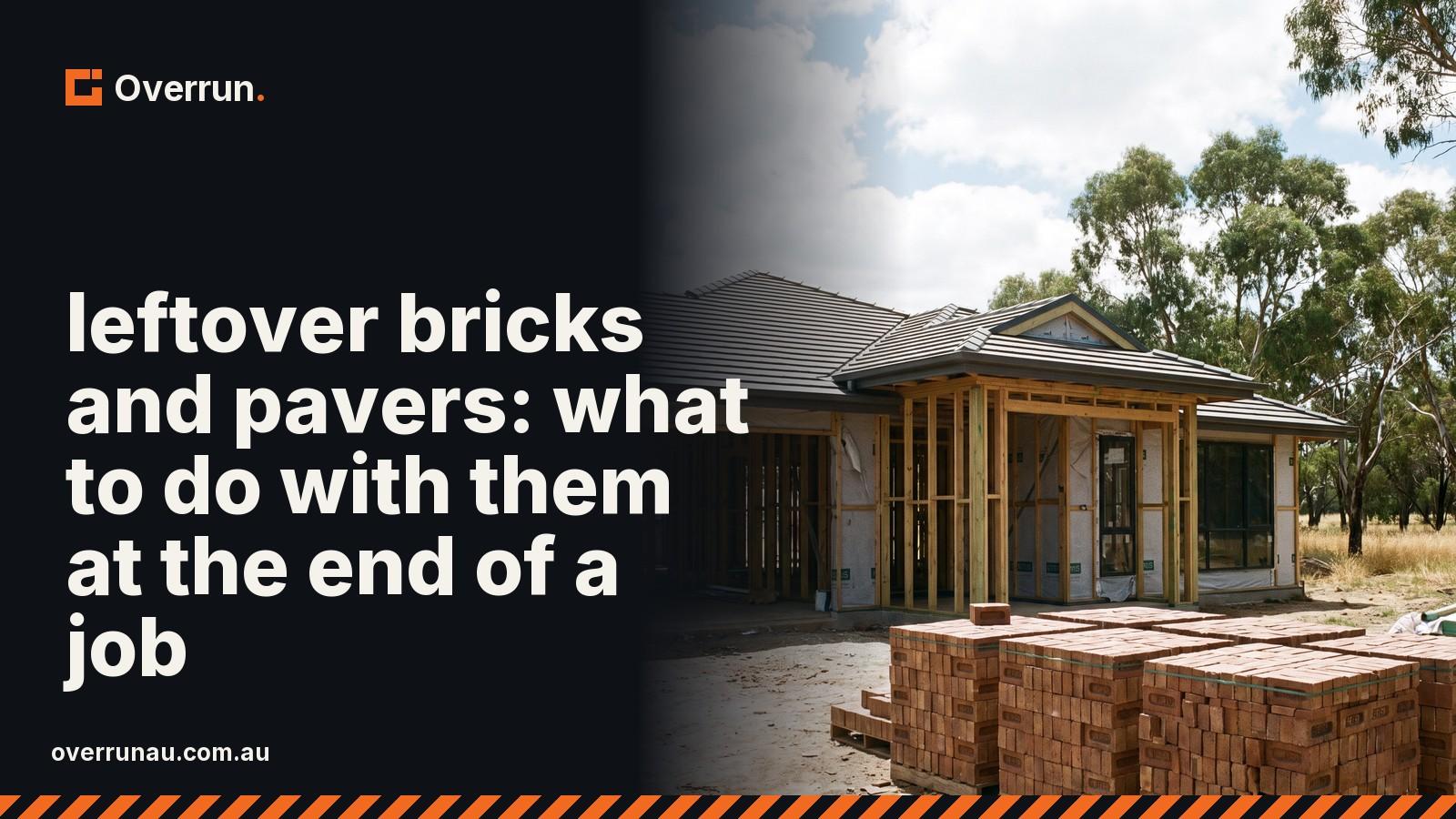
Bricks and pavers are one of the most common things left over at the end of a build or a landscaping job. You order extra for breakages and cuts, like you're meant to, and the job finishes with half a pallet sitting on the nature strip.
They're also one of the worst things to throw out. They're heavy, so they use up a skip's weight allowance long before they fill it. And most of the time they're in perfect condition.
Here's what I'd do with them.
Keep a few back for repairs
Before anything else, put some aside. Bricks and pavers are made in batches, and the colour can shift a little from one batch to the next. If a paver cracks in five years, one from the same pallet is the one that'll match.
A handful is plenty for most jobs. Write the product name, colour and batch number on one of them with a paint pen, or keep a photo of the pallet label on your phone. Stack them somewhere dry and flat. Then deal with the rest properly.
Don't put them in a mixed skip
Bricks, pavers and concrete are heavy. In a skip they eat into the weight allowance fast, and mixed construction waste generally costs more to tip than a clean load. If they really can't be used, keep them clean and separate, because a lot of tips and recyclers treat clean brick and concrete differently from mixed rubbish. Check with yours before you load anything.
But before they go anywhere, it's worth remembering that most leftover bricks and pavers are worth more to someone else than they are to you sitting down the side of the house.
Who actually wants them
More people than you'd think:
- Someone matching an existing wall or path who needs the same brick and can't buy it any more.
- Owner-builders and renovators doing a small extension, a letterbox, a barbecue surround or a garden edge.
- Landscapers and tradies who need a couple of square metres to finish a job, not a whole pallet.
- People who just want them cheap for a path or a shed surround.
The person who needs 60 pavers is never going to buy a full pallet new. That's exactly why your leftovers are useful to them.
Get them ready to go
A bit of prep makes them easier to sell and quicker to collect.
- Stack them on a pallet. It keeps them off the ground and clean, and someone with a trailer can load them quickly. Loose bricks on dirt look like rubbish even when they aren't.
- Count them. Rough is fine. Count one row and multiply. "About 180" is far more useful to a buyer than "heaps".
- Measure one. Length, width and thickness in millimetres. Pavers especially come in a lot of sizes.
- Note the name and colour. If you've still got the pallet label or the invoice, the product name and colour are what a matching buyer will look for first.
- Be clear about condition. New and unused, or reclaimed? If they've been laid before, say whether the mortar's been cleaned off.
Photograph them where they sit
Take the photos in daylight, where the bricks are. No need to move them.
- One of the whole stack, so people can see how many there are.
- One close-up of the face, so the colour is clear. Open shade shows colour better than harsh midday sun.
- One with a tape measure across a brick or paver.
- One of the label, if you've got it.
If some are chipped, show that too. It saves a wasted trip for both of you.
Sort out collection before you list
Bricks are heavy, so collection is the bit that makes or breaks the deal. Say up front whether it's hand-loading or whether you've got a forklift or a pallet jack, whether you can help load, and roughly when they can be picked up. Someone with a ute and a free Saturday morning wants to know they won't be loading 400 bricks on their own.
On price, don't overthink it. You're not trying to get what they cost new. The point is getting them gone to someone who'll use them, instead of paying to dump them. Being clear about what you've got and how it gets collected matters more than the number.
Listing them on Overrun
This is the reason we built Overrun. It's a marketplace for leftover building materials only, so the people looking are after exactly this kind of thing.
List it in about a minute: a few photos, the quantity, the size and the condition. Someone local buys it, pays you directly, and you sort out pickup or delivery between you. Overrun takes no commission on the sale.
If you're a tradie and every job ends with something left over, the Tradie plan is $19 a month, and the first 3 months are free with code 3FREETRADIE. List your overrun at overrunau.com.au.
If you're on the other side, after a few bricks or pavers to match something you've already got, put it on the want list at overrunau.com.au. It's free, you don't need an account, and we'll email you when a match is listed.
Quick answers
Can I put leftover bricks in a normal skip? Usually, but they're heavy and use up the weight allowance quickly, and mixed waste generally costs more to tip. If they really are going, keep them clean and separate and check with your skip company first.
How many spare bricks or pavers should I keep? Enough to fix a few breakages later. A handful from the same batch is plenty for most jobs. Label them with the product name, colour and batch number.
Is it worth selling half a pallet of pavers? Usually, yes. Someone finishing a path or matching an old one may need exactly that quantity, and it saves you paying to get rid of them.