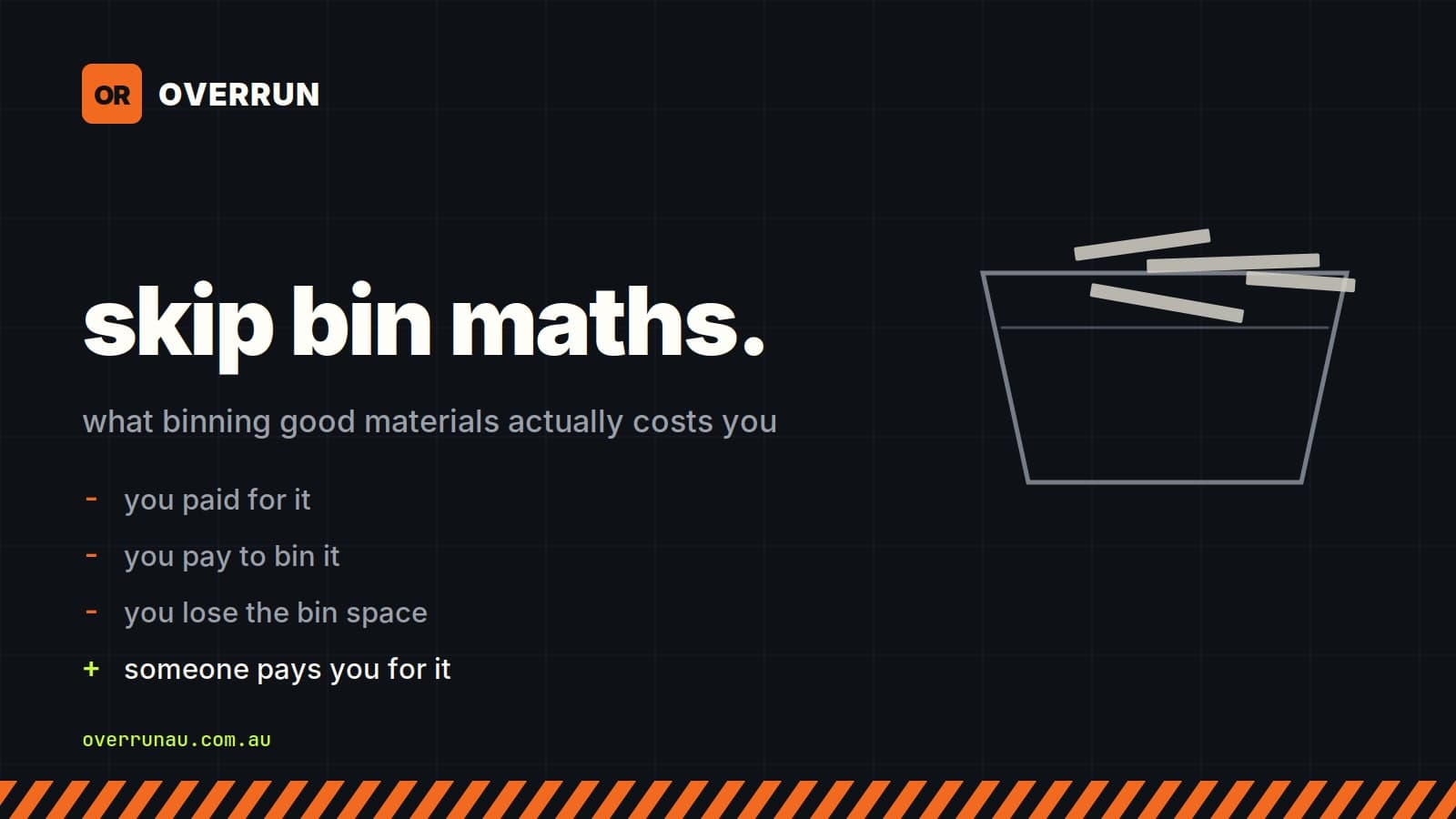
Let me say the quiet part first: skip bins are not the enemy. Every job needs one, and the skip companies we talk to are some of the most practical people in the industry. The problem isn't the bin. The problem is what ends up in it that shouldn't.
Walk past any renovation skip and look. Between the genuine rubbish there's usually a pack of something unopened, lengths of straight timber, tiles still in boxes, fittings with the barcode on. That's not waste. That's stock, lying in a bin someone paid to hire.
The double payment nobody notices
When usable material goes in the skip, you pay twice. You paid for the material when you bought it, and you're paying again for the bin space and weight to throw it away. Skips are priced by size and often surcharged by weight.. heavy things like tiles, bricks and pavers are literally the most expensive things to bin, and they're also the things most likely to still be worth money.
Then there's the third cost, the sneaky one: if usable material is filling a chunk of your skip, that's bin capacity you've paid for that isn't available for actual waste. Enough good material in the bin and you're ordering a second skip for a job that needed one.
What the alternative looks like
The reason good gear goes in the bin has never been laziness. It's time. At 5pm on a Friday, nobody's photographing offcuts for Marketplace and fielding midnight messages from people who never show up.
That's the exact problem Overrun was built to fix, and I know because I built it after years of hearing about it from my husband, who's on the tools. Listing takes under a minute: photo, few details, done. It's an Australian marketplace where only building materials are listed, so the people browsing are tradies and renovators actively looking. Buyer messages you, comes to the site or your place, pays you directly. We never take a cut of the sale.
So the same pallet of pavers has two futures. In the skip, it costs you tip weight. Listed, someone pays you for it and does the lifting.
Doing the sums on a real job
Say a bathroom reno finishes with: a box and a half of tiles, an unopened bag of tile adhesive, a vanity that was ordered wrong and never fitted, and some lengths of framing pine. Binning that lot eats skip space and adds weight. Selling it at sensible second-hand prices is realistically a few hundred dollars back on the job, for maybe ten minutes of listing.
A few hundred dollars per job, across however many jobs you run a year.. that's not recycling feel-good money, that's margin.
And if you run skips for a living
We work with skip bin companies too. The short version: an Overrun sticker on your bins gives your customers a way to rescue the good stuff before it's buried, and there's a referral deal in it for the operator. If that's you, email hello@overrunau.com.au and I'll send the details.
Quick answers
Is it cheaper to sell materials than bin them? Almost always, for anything genuinely usable. Binning costs bin space and weight; selling returns cash and removes the weight for free.
What materials are worth pulling out of the skip pile? Unopened packs of anything, tiles and pavers, straight timber in useful lengths, insulation, fittings and fixtures still in packaging, doors and windows without damage.
How long does listing take? Under a minute per listing on Overrun, from your phone. First 3 months are free with code 3FREETRADIE at overrunau.com.au.